Safety and Family violence

Community-Connection.jpg

Everyone deserves to feel safe in their community, whether you're living here, working, or just passing through Hume City. We all care about safety, and it takes all of us working together to build a city where people feel safe and secure. 

Most people in Hume City, around 80.9%, say they feel safe overall. But when it comes to feeling safe at home after dark, that number drops to 66.6%. That tells us not everyone is having the same experience.  Hume's crime rate is lower than the Victorian average, which is encouraging. But we still see issues like theft, property damage, and breaches of family violence orders. Road trauma is also a concern, with 640 accidents and over 800 injuries or deaths in 2024, higher than the state average. With so many people relying on cars to get around, road safety is a big part of how safe people are daily. 

Hume City is one of Australia's most culturally diverse places, and that's something to be proud of. But even in a diverse community, not everyone feels included. Nearly 18% of adults say they've experienced discrimination, and almost 10% report racism, both higher than the state average. Only 60.7% of residents believe multiculturalism makes life better in their area, compared to 66.5% across Victoria. That tells us we've got more work to do to build trust and inclusion, especially for migrant and refugee communities. 

Family violence continues to be a serious public health issue. We have the third-highest rate of incidents in North-West Melbourne. Most affected family members are women, and nearly half are aged between 25 and 44. What's even more worrying is that 42.6% of these incidents involve children, well above the state average. And while we don't have local data on elder abuse, national figures show that 1 in 6 older Australians experience elder abuse, often from someone close to them. Things like isolation, financial stress, and housing insecurity make people more vulnerable, and those risks exist in many parts of Hume. 

Creating and maintaining a safer, more inclusive city will help build trust, strengthen a sense of community, and ensure every resident feels safe, valued, and connected in the place they call home.  

Key Statistics

  • Hume City has the third highest rate of family violence incidents in North-West Metropolitan Melbourne.
  • Approximately 76% of affected family members in family violence incidents in Hume City are female.
  • Four in five residents (80.9%) are satisfied with how safe they feel.
  • One in ten adults (9.7%) reported experiencing racism over the previous 12-month period, higher than the Victorian rate of 6.9%.
  • The rate of criminal incidents in Hume City for the year ending March 2025 was 6,181 per 100,000 population, lower than the Victorian average of 6,692.

Detailed Context

Feelings of Safety

Three in four (75.0%) Hume residents feel safe walking in the municipality during the day, whilst two in three (66.6%) Hume residents feel safe at home by themselves after dark. Overall, four in five (80.9%) are satisfied with how safe they feel.

Diversity and Discrimination

Three in five adults (60.7%) in Hume believe that multiculturalism makes life in their area better, lower compared to the Victorian rate of 66.5%. Just under one in five (17.7%) adults in Hume reported experiencing discrimination in the previous 12-month period, higher compared to the Victorian rate of 15.8%. Additionally, one in ten adults (9.7%) reported experiencing racism (discrimination due to their Aboriginal status, skin colour, nationality, race, and/or ethnic group), higher than the Victorian rate of 6.9%.

Crime

The rate of criminal incidents in Hume City for the year ending March 2025 was 6,181 per 100,000 population, lower than the Victorian average of 6,692. The top five principal offence types were ‘stealing from a motor vehicle’, ‘other theft’, breach of family violence order’, ‘criminal damage’ and ‘theft of a motor vehicle’. The rate of alleged offenders per 100,000 population for Hume City is 2,401 compared to 3,077 for Victoria. Those aged 45+ years account for the largest proportion of alleged offenders (18.5%), followed by those aged 30-34 years (16.99%).

Road Accidents

There were 640 road accidents and 807 people injured or killed in road accidents across Hume City in 2024 [1]. Hume City had a rate of 297.0 road accidents per 100,000 population, higher compared to Victoria at 257.3. The rate of people injured or who died in road accidents in Hume City is also higher compared to Victoria at 235.5 per 100,000 population compared to 207.7.

Family Violence

In 2023/24, 3,635 family violence incidents were reported in Hume, with an incident rate of 1,344.2 per 100,000 population, slightly lower than the Victorian rate of 1,418.1. Hume has the third highest rate of family violence incidents in North-West Metropolitan Melbourne. Since 2019-20, the rate of family incidents in Hume City has been declining. Hume City currently has the sixth highest rate of family incidents per 100,000 population across Greater Melbourne.

The most common form of abuse is verbal abuse, accounting for 38.7% of recorded abuse types. This is followed by emotional abuse (26.8%) and physical abuse (16.8%).

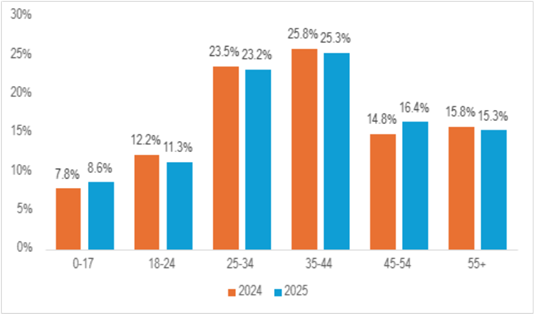
Affected family members of family violence incidents are most commonly aged between 25-44 years of age, with almost one in two (49.4%) affected family members in this age group. Hume City demonstrates a similar breakdown of affected family member by age compared to Victoria. This is indicative of a regression to the norm from a previously high proportion of younger persons impacted by family violence. Approximately 76% of affected family members in family violence incidents in Hume are female, similar to the Victorian average of 75%.

In just over two out of five (42.6%) recorded incidents of family violence in Hume City, a child was present as either a victim or a witness. This is higher than the statewide rate of 36.2%.

Affected family members by age group 2023/24
Criminal Offences Related to Family Violence chart


Criminal Offences Related to Family Violence

Over one in five (22.2%) criminal offences in Hume City in 2023-24 related to family violence incidents. The most common offences were breach of a family violence order (41.7%) and family violence related common assault (17.0%). The rates per 100,000 population of family violence related offences in Hume City are slightly higher in Hume City when compared to Victoria (with the exception of breach of family violence order).

Sexual Violence

Sexual offences include rape, indecent assault, and other acts of a sexual nature against another person, which are non-consensual or where the person is deemed incapable of giving consent because of youth or temporary or permanent incapacity. In Victoria, sexual violence is overwhelmingly perpetrated by men against women, about one third of reported sexual offences are related to family violence. In 2023-24 sexual offences in Hume City occurred at a rate of 12.2 per 10,000 people for females and 1.5 for males. Both rates are slightly lower than the Victorian averages (15.4 and 2.8 respectively).

Elder Abuse 

Local level data on elder abuse is not available, however, a 2021 Australian study by the Australian Institute of Family Studies found that one in six older people experienced elder abuse. An older person is defined as being over 65 years (or over 50 for Aboriginal and Torres Strait Islander people). The number of older people who experience abuse is likely higher as older people are often reluctant to report abuse. The most common types of elder abuse were financial abuse, physical abuse, sexual abuse, psychological (emotional) abuse and neglect. Over one in two (53%) elder abuse perpetrators were family members. However, the most common perpetrator varies according to the type of elder abuse. For example, just over two in three cases of financial abuse of older people was carried out by a family member, whilst sexual abuse of older people was predominantly perpetrated by friends (42%).

Socio-demographic characteristics associated with an increased likelihood of experiencing elder abuse include being separated, divorced or never married, having stepchildren, owning a home with a mortgage or renting (including living in public housing), and or living in a disadvantaged area. Experiences of elder abuse are associated with poorer physical health, poorer psychological health and a lower sense of social connection.